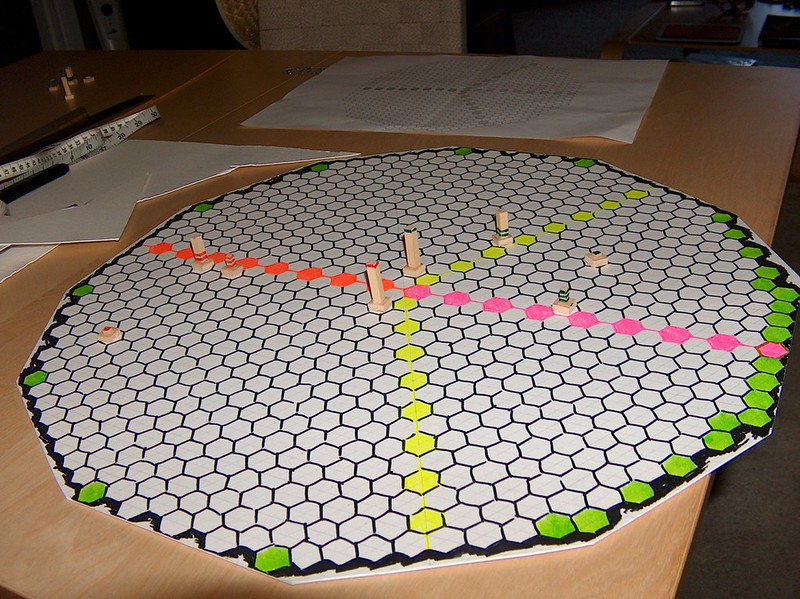
For my novel, The Soldier, the Wizard, the Lady and the King, I wanted a scene of King So‘osolopo playing a strategy game with his advisors. I did not, however, want to copy an existing game like chess or go. I therefore designed, built and play-tested my own board game, “The Knights of Tékazara”.
The board is circular, comprised of small hexagon spaces (30 spaces in diameter).
The game can be played by two or three players. Each starts with either four, seven or thirteen knights (the players agree to the same amount). The goal of the game is to capture the opponent’s weakest knight. Each knight is ranked. When a knight is moved onto an occupied space, the stronger knight always wins and the weaker knight is removed from the board. A tie would go the defender.
The basic board is blank, but roads and terrain can be added. I took an actual map of one of the counties of Tékazara (near the border with Nyıkãgo and Dænkíchı) and recreated the hills, forests and roads into sections of board that can be laid over the main board. They can either be arranged to form realistic terrain or dropped onto the board at random (and straightened to match the hexagon pattern).
Players start by taking turns placing their knights, strongest to weakest, anywhere on their side of the board. Then in game play, each player moves all of their knights in sequence, strongest to weakest.
Each knight can only move one space per turn, unless it’s on a road or a clearing, where it moves two spaces, or on a slope, where it moves an extra space downhill. If a knight captures a piece on the first hexagon on a road or clearing movement, it doesn’t move a second hexagon. If a slope pushes a player’s knight into another of their knights, only the strongest one remains.
For strategy, I settled on keeping the strongest knight near the weakest knight, trying to protect it, while the middle-strength knights try to circle the opponent and overload the defenses—while also helping defend.
The three-player game involves diplomacy, since even if you team up with an opponent, you can’t trust them for long.
I also originally envisioned the soldiers playing a card game similar to poker. Although it turned out the squad didn’t have time for games that day, I did include people playing cards in Laví’s section.
Rather than copy a deck from history, I created one to fit Narakan society. There are four suits, but of uneven sizes. The suits are based on the calendar cycles, so the suits have four cards, seven cards, thirteen cards and 25 cards. The short suit is the elements (water, air, fire, earth) represented by the high gods and goddesses. The seven-card suit is the seven fourdays in a month. The thirteen-card suit is the months of a year, while the 25-card suit is the years of a Cycle.
I designed a poker-style game, choosing target hands and calculating odds for each. I then played several hands of the game and recorded the gameplay into the story, while the characters talked and reacted. That was twenty years ago, however, and that version of Manío’s story is just some alternate universe now.
I also designed a trick-taking game akin to bridge or spades, called Calendar, but it’s not in a story yet, either. Since the cards are related to the calendar, you can form the day’s date with one card from each suit. In Calendar, those four cards are the highest-ranked card in each suit, so the game will change every day. The other cards are ranked by how close to the top card they are (e.g. on an airday, water and fire would be equal and earth the lowest). All of the four-card suit is ranked higher than the seven-card suit, and so on.
All the cards are dealt (four players usually), then the players bid how many tricks they expect to take.
For each trick, the players must follow suit if a card from the date is played. For any other card led, they must follow suit or play a card from an adjacent suit. If they can’t, they sluff face-down onto a discard pile to the side. If two players’ cards are equally the highest card in the trick, they each must play another card to determine the winner. If they tie again, this repeats. Whoever wins the trick then leads for the next trick. The hand ends when the player who’s supposed to lead doesn’t have a card. It’s thus possible for the hand to end while some players still hold cards. A chaotic player can really mess with others’ bids. Scoring is the number of tricks taken plus the bid (or minus the bid if you don’t make it). First to 49 points wins.
Comments
Post a Comment